
In the world of hunting and tactical operations, especially at night or in low-light conditions, choosing the right thermal scope can be a game-changer, particularly for beginners. But you may feel overwhelmed when navigating the 2025 market’s technical jargon and price variations. This guide simplifies the process by breaking down 3 critical metrics and recommending 3 budget-friendly thermal scopes that deliver professional performance without breaking the bank.
Key Metrics to Consider for Beginners
Sensor Resolution: Clarity vs Budget
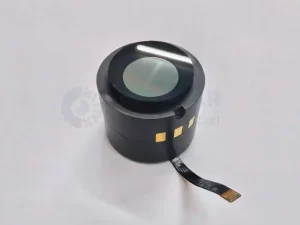
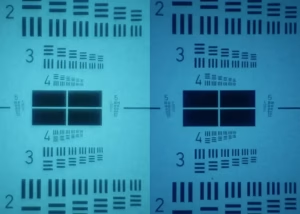
Sensor resolution is the most significant factor affecting image quality and price. Higher resolutions (e.g., 640×512) provide sharper visuals but cost upwards of $4,000. For beginners, a 384×288 resolution (e.g., the TGS335 model) strikes the perfect balance between detail and affordability, enabling target detection up to 1,800 yards.
As for sensors with a resolution below 256×192, they are indeed much cheaper, but they produce blurry images beyond 200 yards and are only suitable for close-range use.
NETD: Why Thermal Sensitivity Matters
What is NETD ?NETD (Noise Equivalent Temperature Difference) measures a thermal scope’s ability to distinguish subtle temperature differences. Lower NETD values mean better sensitivity.
Ideal Range: ≤35mK ensures solid performance for most scenarios. Advanced models like the TGS335 achieve ≤25mK, making them excellent for hunting and tactical needs.
Pro Tip: Prioritize NETD ≤25mK if you operate in fog, rain, or dense foliage.
Optical Magnification: Matching Lenses to Use Cases
Thermal scopes typically employ fixed – focus lenses. Lenses with different focal lengths correspond to various optical magnification ratios. The lens functions like a telescope, and the thermal imaging sensor is analogous to our eyes. Just as we can clearly view distant scenery through a telescope, a lens with a high magnification factor has a similar effect, enabling us to see farther with almost no loss of image quality. In contrast, digital zoom significantly degrades image quality as it simply enlarges the image directly. Certainly, a larger lens is not necessarily better. Although it can extend the detection range, it will narrow the field of view and increase the cost. Therefore, we should choose a thermal scope based on their specific usage scenarios.
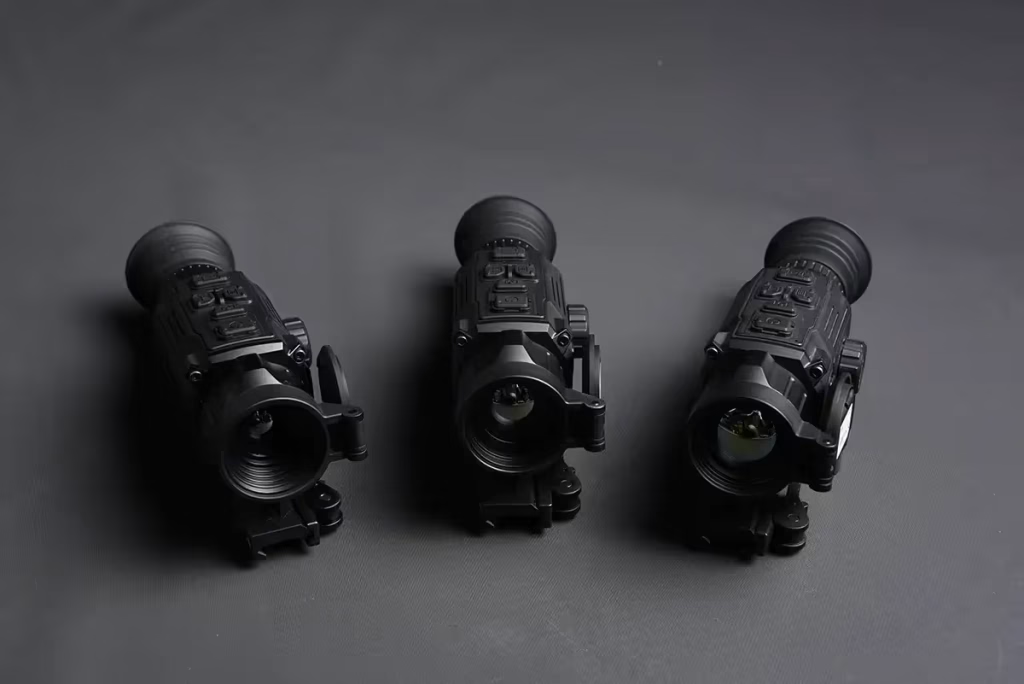
Example: INFREDAR TGS series offers three lens options:
- TGS225 (25mm lens, 2.5x base magnification)
- TGS335 (35mm lens, 3x base magnification)
- TGS450 (50mm lens, 4.5x base magnification)
Beginner Advice: Pair a mid-tier sensor (e.g., 384×288) with a long-range lens for cost-effective long-distance clarity.
How to Choose the Best Thermal Scope for Beginners
By following these three steps, you can make a wise choice without much effort.
1.Define Your Primary Use Case
- Detection Range & Target Size: Determine the resolution and lens magnification needed for your typical shooting distance.
- Environment: Harsh weather demands higher thermal sensitivity (NETD ≤25mK) and rugged durability. Long sessions require extended battery life.
- Firearm Compatibility: Match the scope’s recoil resistance to your weapon’s power.
- Extra Features: WiFi (for live streaming) and laser rangefinder are nice-to-haves, but prioritize core metrics (resolution, NETD, magnification) first.
2.Set a Realistic Budget
Entry-level thermal scopes start at $800–1,500 in 2025. Allocate funds to maximize sensor resolution and NETD before adding extras.
3.Research & Compare Products
Focus on brands with proven durability and warranty support. Read third-party reviews and test units in-person if possible.
Top 3 Cost-Effective Thermal Scopes AROUnD $1000 in 2025
Here, we introduce the three best thermal scopes for beginners.
| Products | AGM Rattler V2 (19-256) | TGS225 | DNT TNC225R |
| Sensor | 256×192, 12μm, 50Hz | 384×288, 12μm, 50Hz | 256×192 12μm, 50Hz |
| NETD | ≤20mK | ≤35mK | ≤25mK |
| Display | 1024×768 OLED | 1024×768 AMOLED | 1024×768 OLED |
| Lens Options | 19mm | 25mm | 25mm |
| Digital Zoom | X2, – X20 | X2.5, X5, X7.5 | 3X,6X,9X,12X |
| Battery Life | ~ 6 hours | ~ 6 hours | ~ 5 hours |
| Dimensions | 219 × 68 × 67 mm | 335*80*48mm | 170x84x79mm |
| Weight | 480g | 560g | 650g |
| Key Features | Video recording, WiFi, adjustable contrast | 8 color modes, WiFi, ultra-light design | Thermal/Night Vision Combination,LRF |
| Storage | Built-in EMMC (16 GB) | TF Card(64GB MAX) | Built-in EMMC (32 GB) |
| Price | ~$845 | ~$999 | ~$1099 |
1. AGM Rattler V2 (19-256)

Pros:
- Affordable Price: The AGM Rattler V2 (19-256) offers excellent value for its features at a relatively low cost, making it a great option for beginners or those on a budget.
- Lightweight Design: Weighing in at just around 500g, this thermal scope is easy to carry and handle, which is ideal for long hunts or when weight is a concern.
- WiFi Connectivity: The scope comes with built-in WiFi, allowing you to stream images and videos directly to your mobile device for easier viewing and sharing.
- Durable and Compact: It’s built with a sturdy design that’s both compact and rugged, perfect for various outdoor conditions.
Cons:
- Lower Resolution: With a 256×192 sensor, the image quality may not be as sharp or detailed as higher-resolution scopes, limiting its performance in certain scenarios, especially at longer distances.
- Smaller Lens: The 19mm lens (with some configurations available) reduces the detection range, making it less effective at spotting targets from long distances compared to scopes with larger lenses.
- Shorter Detection Range: Due to its lower resolution and smaller lens, the AGM Rattler V2 (19-256) is better suited for close to medium-range detection, which may not meet the needs of hunters looking for long-range performance.
2. REDAR STARLIGHT225

Pros:
- High 384×288 Resolution: The REDAR TARLIGHT225 offers excellent image clarity with its 384×288 resolution, a feature that’s rare in this price range. This makes it ideal for clearer detection and more detailed images.
- AMOLED Display: The AMOLED screen provides better contrast, sharper images, and richer colors, making it easier to identify your target even in low-light conditions.
- WiFi Connectivity: Like the AGM Rattler V2, the REDAR STARLIGHT225 supports WiFi, allowing you to easily transfer images and videos to other devices for review or sharing.
- 8 different Palettes: The REDAR STARLIGHT225 offers multiple palettes, giving users the ability to customize the display for different environmental conditions or preferences.
- Expandable Memory: The REDAR STARLIGHT225 supports memory expansion of up to 64GB, allowing you to store more images and videos without worrying about running out of space.
Cons:
- No Automatic Recording during Shooting: Unlike some other scopes, the REDAR STARLIGHT225 does not have the ability to automatically record footage when the user takes a shot, and you have to click a button to do this instead.
- The length may be too long: The traditional scope design makes it less suitable for certain firearms, though it’s more ideal for bolt-action rifles.
3. DNT TNC225R

Pros:
- Dual Night Vision and Thermal Imaging: The DNT TNC225R combines both night vision and thermal imaging capabilities, making it versatile for various lighting and environmental conditions, whether in total darkness or challenging weather.
- Laser Rangefinder: This model comes equipped with a built-in laser rangefinder, adding an extra layer of precision for target distance measurement, which is useful for both hunters and tactical users.
Cons:
- Lower Resolution: Like the AGM Rattler V2, the DNT TNC225R has a 256×192 resolution, which may not deliver the same level of detail and image clarity as higher-resolution models like the STARLIGHT225.
- Heavier Weight: Weighing around 650g, the TNC225R is on the heavier side compared to other thermal scopes, which might affect its comfort and portability during long hunts.
- Relatively High Price: At $1099, it is more expensive than some other models, While it offers unique functionalities like dual imaging and a rangefinder, the price may not be justified for users seeking simpler solutions.
Conclusion:
- If you’re looking for affordability, lightweight design, and WiFi support, the AGM Rattler V2 (19-256) is a great entry-level option, though it lacks some of the resolution and lens capabilities of higher-end models.
- The REDAR STARLIGHT225 provides the best resolution and AMOLED display at this price range, making it ideal for those who prioritize image quality and color modes, despite lacking automatic recording.
- The DNT TNC225R offers dual night vision and thermal imaging and laser rangefinder, but its high price and lower resolution make it a less cost-effective choice for beginners who don’t need all of these features.
All in all, no single best thermal scope is ideal for everyone—it all depends on your unique needs and preferences. Choosing the best thermal scope as a beginner boils down to three pillars: sensor resolution, thermal sensitivity (NETD), and optical magnification. By aligning these metrics with your budget and use case, you can avoid overspending while gaining professional-grade performance. While advanced features like rangefinders or WiFi are enticing, prioritize core functionality first. With the 2025 market offering unprecedented value for money, there’s never been a better time to invest in a thermal scope that grows with your skills.
We hope this article helps you choose the right thermal scope for your specific requirements. If you have any questions or suggestions, feel free to leave a comment below.