China’s NNVT image intensifier tubes have earned significant global recognition in recent years, driven by their competitive pricing and consistently reliable performance. However, through our industry engagement, we have noted that many professionals and enthusiasts have yet to gain extensive hands-on experience with NNVT technology—a situation that is entirely understandable given the specialized nature of the field.
To provide a transparent look at the real-world performance of NNVT image intensifier tubes, we have curated a collection of field-test results from industry professionals. The technical data and imagery featured in this article are sourced entirely from independent third parties. We would like to extend our sincere gratitude to Cold Harbour Supply and Custom Night Vision for their rigorous professional evaluations and for sharing these invaluable insights with the community.
Prefer watching over reading? We’ve also summarized these NNVT performance tests in the video below. You can dive into the details however you like!
Testing Methodology
The Canadian distributor Cold Harbour Supply has conducted extensive evaluations across a broad spectrum of image intensifier tubes. For this technical review, we have highlighted their direct side-by-side comparison between NNVT4/NNVT4-AG and Photonis ECHO tubes.
These units were tested across 9 distinct real-world scenarios. We have featured 8 of those evaluations here; the ninth was excluded as the light levels were so extreme that neither the NNVT nor the ECHO tubes could produce a functional image, making a meaningful comparison impossible.
Technical Specifications: As shown in the specs below, the test focused on the NNVT4, which serves as NNVT’s entry-level offering. In this specific performance bracket, NNVT provides an exceptional price-to-performance ratio. It is also worth noting that current high-end NNVT Gen 2+ tubes have now evolved to reach FOM levels of 2500+.”
| Model | NNVT4 | NNVT4AG | ECHO |
| FOM | 1451 | 1672 | 1966 |
| SNR | 22.67 | 26.12 | 29.35 |
| Res | 64lp/mm | 64lp/mm | 67lp/mm |
| Gain | 12400 | 11000 | 9677 |
Now, let’s take a closer look at the side-by-side performance of NNVT and Photonis image intensifier tubes across a range of lighting conditions and environmental settings. We’ll examine how they differ in real-world applications.
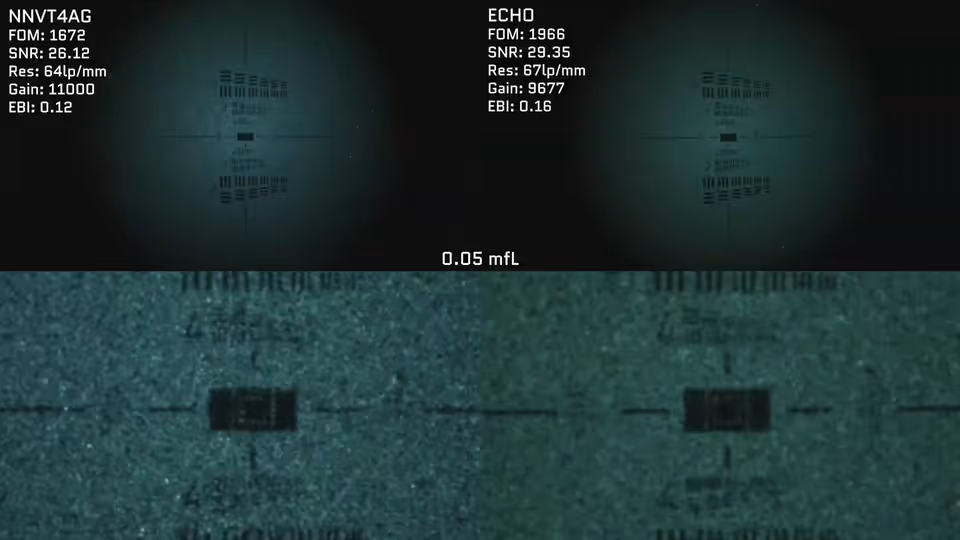
Scenario 1: Hoffman Resolution & Gain Lab Test
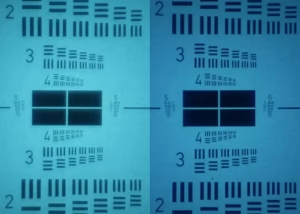
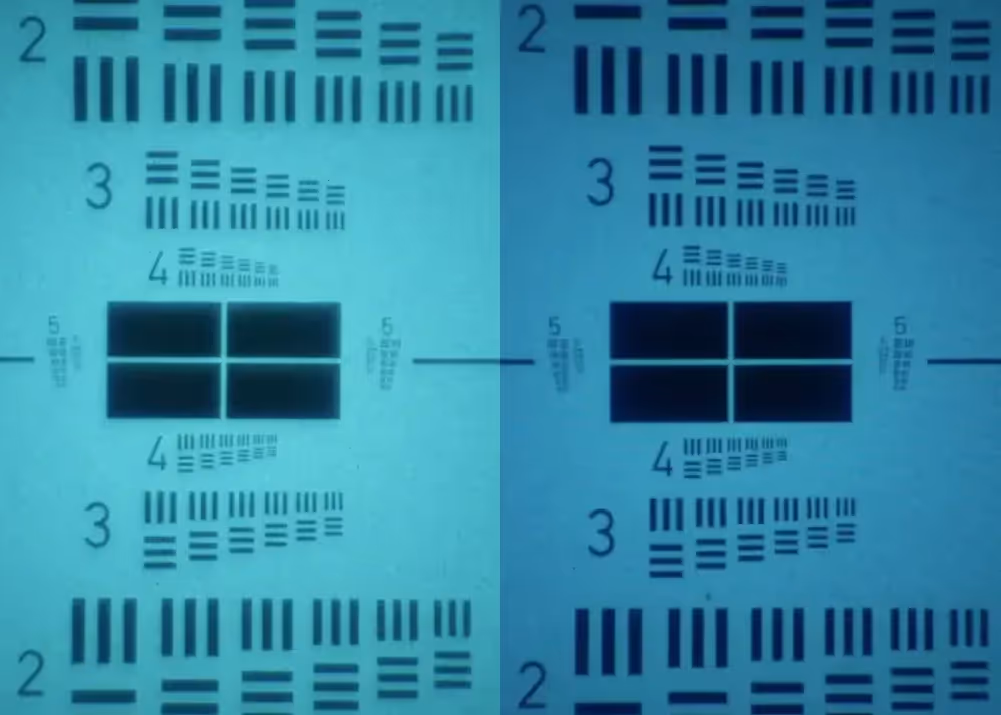
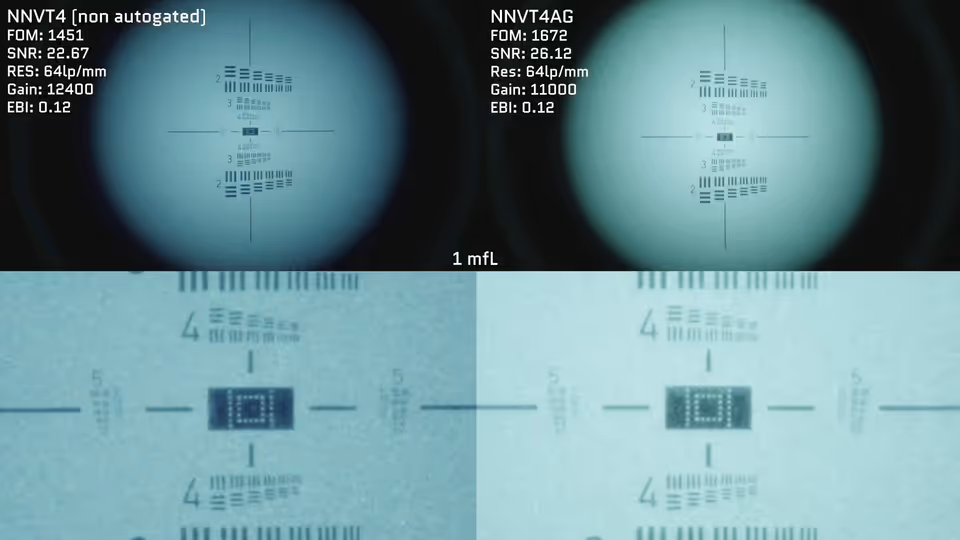
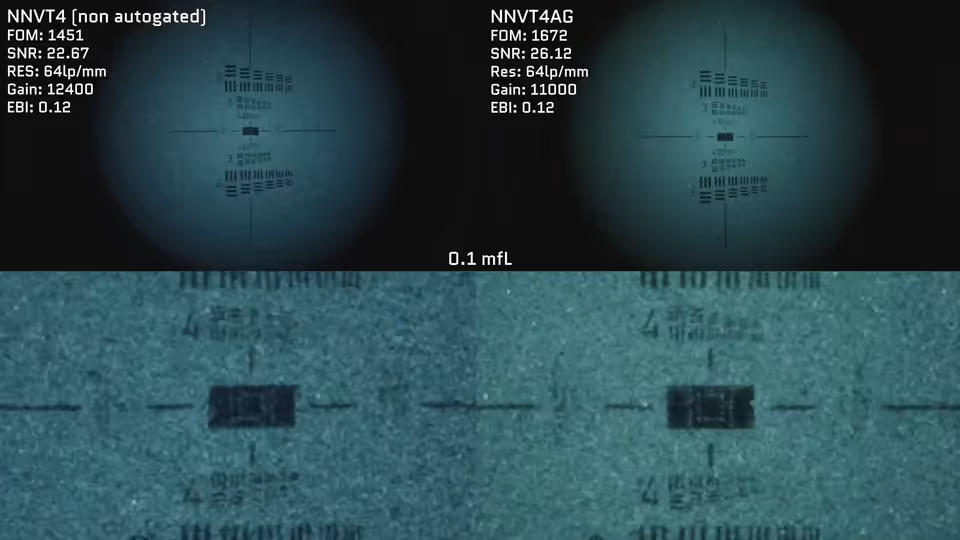
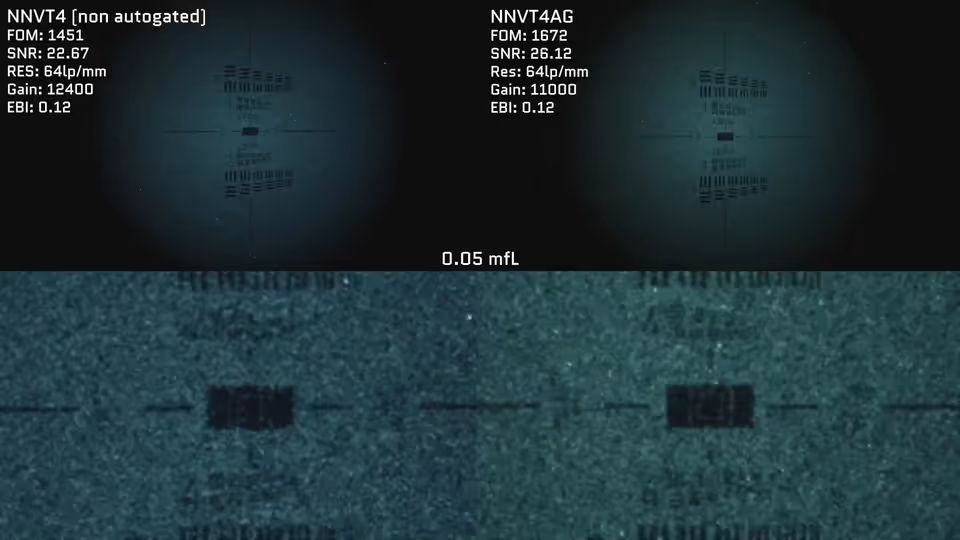
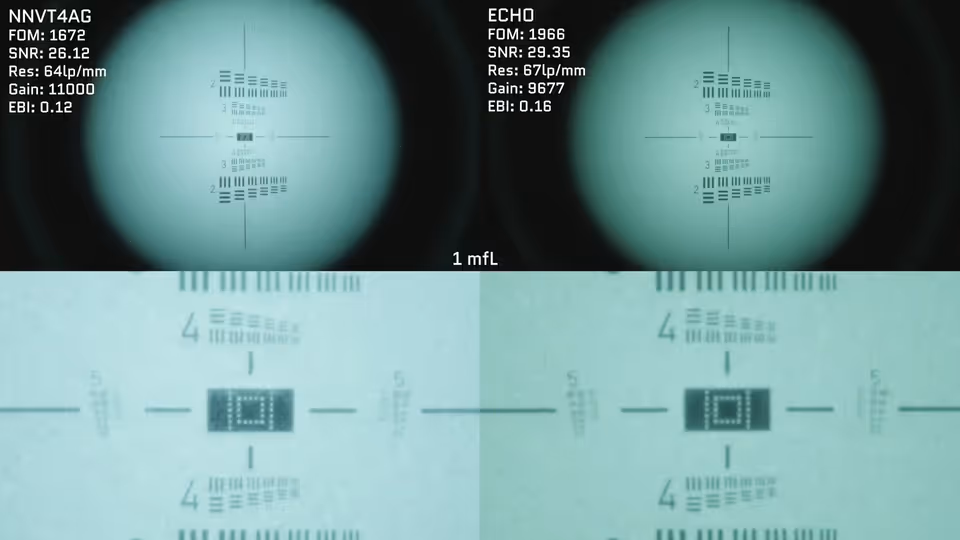
The Hoffman test is like an eye test for NODs. As the light intensity gradually decreases, you can clearly observe how each image intensifier tube renders fine details such as “line pairs”. A key advantage of this test is its controllable light intensity and absence of external light interference — it allows you to get an intuitive sense of each tube’s performance under identical conditions.
All three tubes are white phosphor. We can observe differences in their color rendering styles. As the light intensity decreases, you’ll notice a significant increase in image noise. Although the NNVT tubes have lower specifications, their noise control capability is very close to that of the ECHO tubes.

Scenario 2: Suburban Lighting / Vehicular Test
This test was conducted outdoors in the suburbs, with the image intensifier tubes held by hand inside a moving car—simulating a commonly used scenario. It’s a highlight test, where the light mainly comes from street lamps and car headlights.
We can observe how different tubes render the environment under these lighting conditions. We can notice that all tubes will have very small halos, and see some flare artifacts coming off the lights in the Photonis tube. This isn’t a defect of the tube; it’s just because Photonis tubes render images in a different way, and it’s not too distracting in my opinion.
Scenario 3: Storefront Autogating Test
This test’s happening right at a store entrance, with tons of LED lights around and cars passing by now and then. It’s a great way to see how these image intensifier tubes perform in messy urban lighting.
As we can see, the NNVT4 non-autogated version shows no flicker at all because it doesn’t feature autogating technology. On the flip side, both the NNVT4 Autogated and ECHO tubes do show some flicker since they’re equipped with autogated power supplies, and the NNVT4 Autogated’s flicker is a bit more obvious. That’s mainly due to its slower gating speed compared to the ECHO, which makes it sync up closer to those LED light frequencies. It’s a key thing to keep in mind when picking a tube. Sure, autogating has a bunch of perks, but non-autogated ones like this still hold up really well in complex city environments—plus!They come at a more affordable price point.
Scenario 4: Muzzle Flash Test
Muzzle flashes are likely the most intense and brightest light sources that most night vision users will encounter in real-world usage. In slow motion, we can see that although the NNVT4 is non-autogated, it still protects itself via BSP (Bright Source Protection) from bright light sources—however, it does so at a slightly slower speed than ECHO. And the NNVT-4 AG sits somewhere in the middle of this. As we switch the playback speed to normal, you may notice this actually doesn’t make as big a difference as you think. Unless you have the chance to use full-auto, the BSP function is quite sufficient.
Scenario 5: Riverbank Test With Full Moon
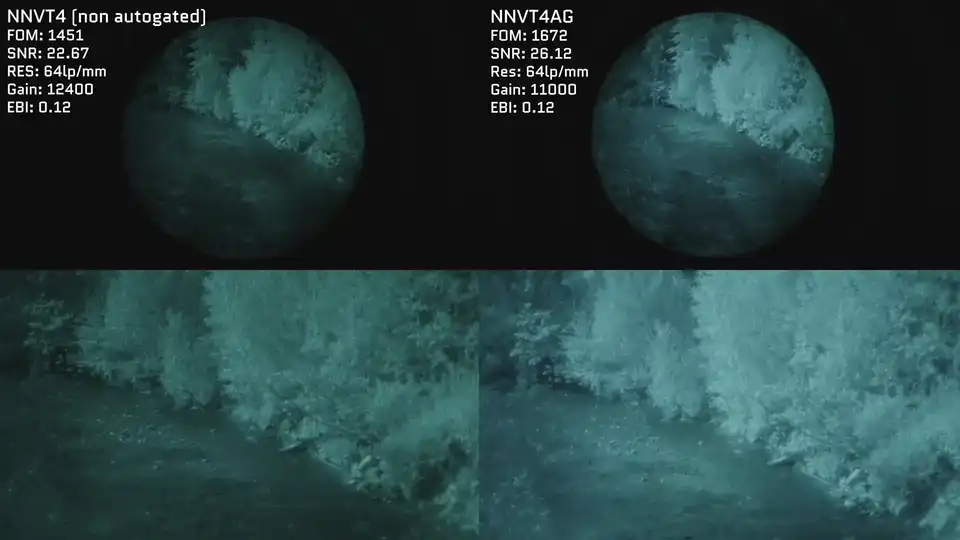
This test was conducted by the river, under a full moon with little to no obstruction. We observed the flowing water through NODs. It’s a highly practical scenario for users who frequently navigate complex terrains. Due to the relatively ample lighting, there is little difference in performance among the three image intensifier tubes.

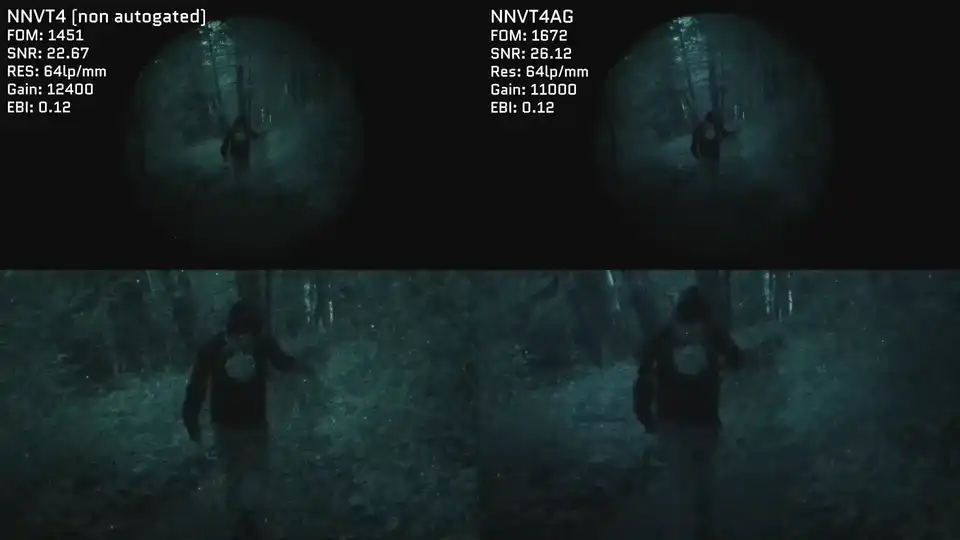
Scenario 6: Forest Hike Test With Medium Canopy
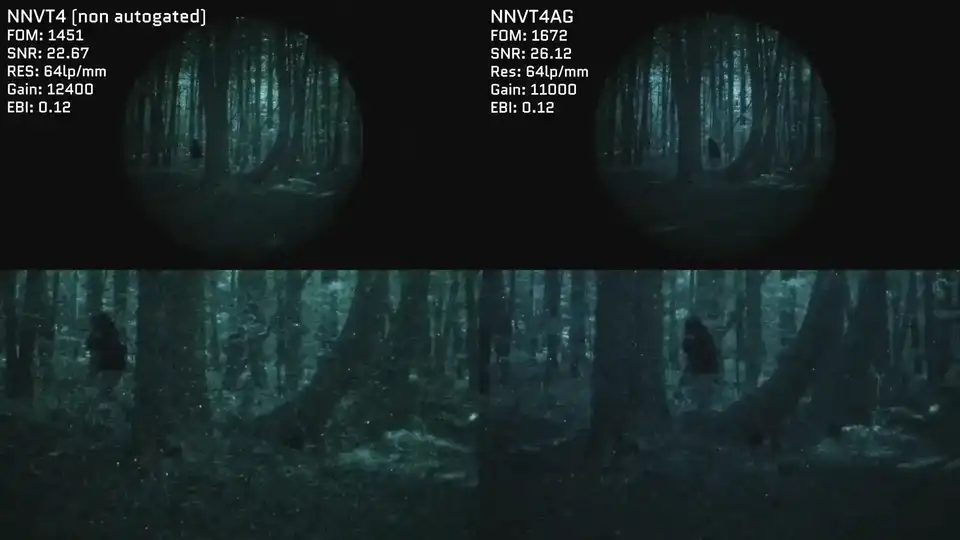
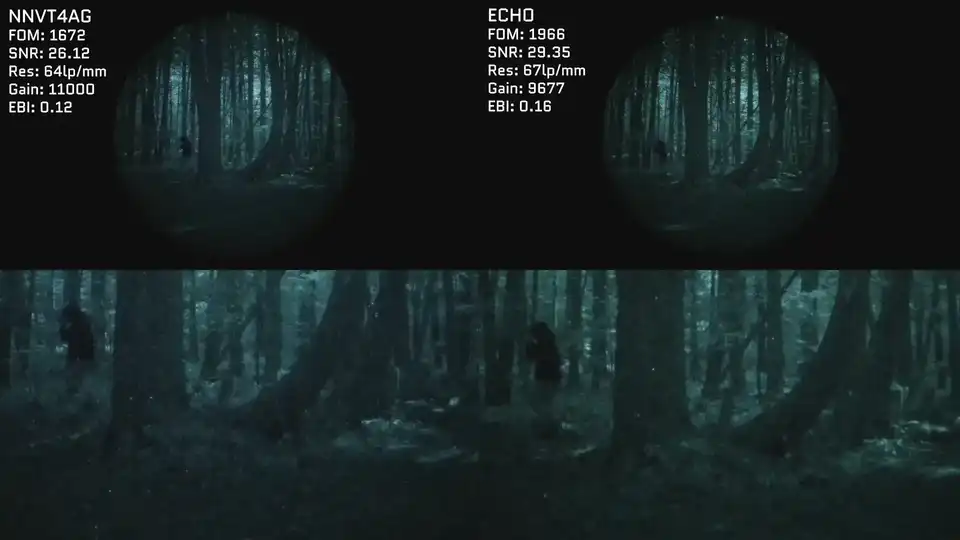
This test was conducted in a forest with moderately dense tree canopies, where the light levels are significantly lower. You can see that the image noise has increased noticeably—by comparison, the NNVT-4 exhibits prominent noise, while the NNVT-4 Autogated and Photonis ECHO perform better and are closely matched.
Scenario 7: Deep Forest Test with Heavy Canopy
This test was conducted in a denser forest, where moonlight is blocked by the hill—resulting in significantly darker conditions than before, which poses a greater challenge for those tubes. It’s harder to make out fine details in the image, and there’s more noise. Once again, the NNVT4-autogated and ECHO outperform the non-autogated NNVT-4. However, the NNVT-4 can still basically make out the path ahead, which is more than sufficient for navigating.

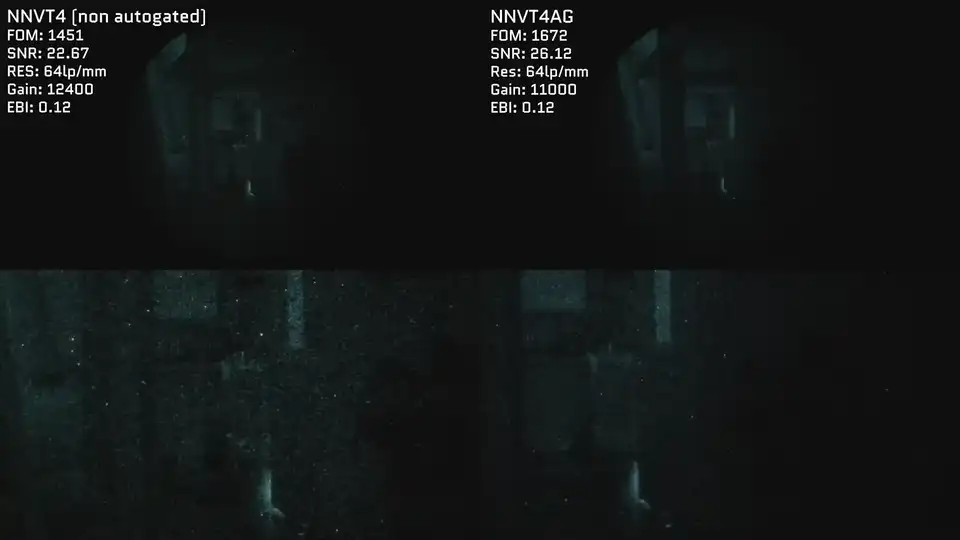
Scenario 8: Indoor Basement Stairwell Test
This test was conducted in a basement staircase. The lighting is extremely dim, with only a tiny bit of light seeping in from the adjacent room. It’s an extremely harsh environment where you can barely make out objects in the frame. Here, we can observe that the ECHO outperforms the NNVT4 AG slightly in noise control and detail rendering—consistent with the differences in their pricing and specifications.

After seeing the results from Cold Harbour Supply, let’s switch gears and look at another perspective—this time from Custom Night Vision. As one of the leading U.S. retailers that pioneered the use of NNVT tubes, they’re well-known for their ‘custom build’ approach, allowing users to hand-pick their housings and tubes. Their testing is fantastic because it’s deeply rooted in real-world scenarios.
| Model | NNVT4 | ECHO |
| FOM | 1502 | 2330 |
| SNR | 22.1 | 32.3 |
| Res | 68lp/mm | 72lp/mm |
| Gain | 13000 | 9730 |
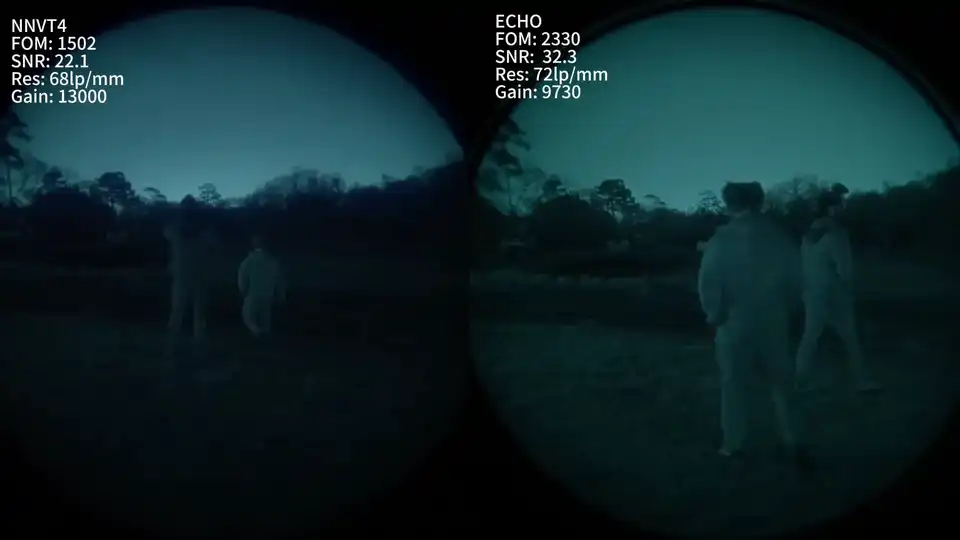
Now, a quick disclaimer before we watch: In this specific test, they are comparing an NNVT with a 1502 FOM against a Photonis ECHO at 2330 FOM. Because of that significant gap in specs, you’ll definitely notice a difference in brightness and clarity. However, even with that disadvantage, the original video points out that the NNVT tube holds its own remarkably well in several scenarios—especially when you consider the price point and overall value. Without further ado, let’s see the results.
Scenario 1: Pure Starlight Environment
This test was conducted in an open area with 0% moonlight, no cloud cover, and illumination relying solely on starlight plus passive ambient light from distant streetlights and houses—all filtering through the trees. You can easily notice a much larger spec gap in this comparison: the ECHO’s FOM exceeds 2,300, while the NNVT’s is just over 1,500. The difference is even more pronounced, and of course, so is the price gap between them.
Scenario 2: Urban Building and Vehicle Lighting
This test was conducted just outside downtown Houston. There aren’t many street lights nearby, but city lights and passing vehicles are visible in the distance, light sources like building windows and streetlights are creating noticeable halos. They are panning across the scene to show how the image intensifier tubes perform when facing different light sources.
Scenario 3: Urban Street Deep Shadow Penetration Test
This test was conducted on a street in an outlying Houston neighborhood. Streetlights serve as the primary illumination here, and trees and buildings cast extremely deep shadows. The image intensifiers can help us see those details hidden in the shadows, such as that car in the darkness. It actually seems that we can see it more clearly through the NNVT tube. That’s truly unexpected because the specs of NNVT are much lower than the ECHO’s.
I hope these third-party comparisons have given you a clear picture of how Chinese image intensifier tubes actually perform. While they might not be chasing the absolute top-tier bleeding-edge specs in every single category, their performance at this price point is honestly unbeatable.
After years of technical evolution, brands like NNVT have proven their reliability—most models now offer a service life of up to 10,000 hours. Plus, with a stable supply chain and a massive production capacity of tens of thousands of units per year, availability is never an issue.
Keep in mind, the tubes we saw today were mostly NNVT’s entry-to-mid-range options. Those high-end models with FOM 2000+ (Now can over 2500) deliver even more stunning results. Thanks to their scale and full supply chain integration, we’re able to maintain elite quality while keeping the costs highly competitive.
At Infrareder, we are your comprehensive one-stop provider for night vision industrial solutions. Beyond just supplying NNVT tubes, we specialize in supply chain integration, offering everything from high-quality housings to essential core components.
Our strength lies in our full OEM and ODM capabilities—whether it’s custom branding or large-scale technical assembly, everything is engineered to meet your specific requirements. We don’t just sell parts; we provide the stable supply chain infrastructure your business needs to grow.