A Serious New Option for Elite Optics
You’ve been there—low-crawling through wet brush at 3 a.m. or grinding out a long night patrol with a dual-tube system strapped to your helmet. After four or five hours, it’s not the gain or resolution you’re cursing. It’s the weight. At 1.32 g/cm³, PEEK is roughly 1/5 the weight of steel and nearly half the weight of aluminum. On a helmet-mounted system, that 50% reduction in housing mass transforms a “neck-breaker” into a balanced, professional tool.
Today, the same material technology allowing the Tesla Optimus-Gen2 to shed weight is being applied to the next generation of Night Vision Devices (NVDs).
What Makes PEEK Different?
PEEK (Polyetheretherketone) is a semi-crystalline high-performance thermoplastic with a molecular structure that rivals the durability of metal.
Extreme Specific Strength: When reinforced with carbon fiber, PEEK’s specific strength (strength-to-weight ratio) can reach nearly double that of 6061-T6 aluminum. This allows for thinner housing walls that survive high-impact drops without the permanent deformation common in metals.
The “Zero-Grease” Advantage: One of PEEK’s most disruptive traits is its friction coefficient (0.15–0.25). In the precision mechanics of an NVD—such as interpupillary adjustment sliders—PEEK components operate smoothly without lubrication, preventing desert sand from sticking to greasy joints.
Inherent Flame Retardancy: PEEK meets the UL94 V-0 standard without any chemical additives. In the event of an electronic short or battery fire, the housing won’t contribute to the burn or release toxic smoke.
The Trade-offs: Engineering Realities
While PEEK offers elite performance, it is not a “magic bullet” for every application. To maintain technical transparency, operators and engineers must consider its limitations:
High Material Cost: PEEK is significantly more expensive than aluminum or standard polymers like Nylon. The raw material price is often compared to high-end aerospace alloys, making it a choice reserved for flagship systems where weight and durability are non-negotiable.
Manufacturing Complexity: Due to its high melting point (approx. 343°C), PEEK requires specialized injection molding equipment or slow, precise CNC machining. This increases the initial tooling investment and production lead times.
Anisotropy in Reinforced Grades: When carbon fiber is added to increase stiffness, the material can become anisotropic, meaning it is stronger in one direction than another. This requires sophisticated structural design to ensure the housing doesn’t have “weak spots” under specific impact angles.
Absolute Stiffness: While PEEK has incredible specific strength, it still has a lower Young’s Modulus (stiffness) than steel or titanium. In designs requiring absolute zero-flex under extreme mechanical loads, hybrid metal-polymer constructions are often necessary.
Where PEEK Delivers in the Field
The real value shows up once the gear leaves the bench.
Thermal Stability: PEEK maintains its dimensional integrity from -30°C to 120°C. Whether in a humid jungle or a freezing high-altitude environment, the housing won’t swell or contract, keeping your optical alignment dead-on.
Chemical Immunity: Aside from concentrated sulfuric acid, it is resistant to almost every organic solvent, oil, and salt spray.
Reduced Signature: As a non-metallic material, PEEK can lower a device’s thermal signature compared to sun-soaked aluminum, which holds and radiates heat.
Comparison: The Material Stack-Up
| Feature | Aerospace Aluminum (6061) | Magnesium Alloy | Reinforced PEEK |
| Density | ~2.70 g/cm³ | ~1.80 g/cm³ | ~1.32-1.45 g/cm³ |
| Corrosion | Risk in salt/humidity | High risk | Impervious |
| Cost | Moderate | High | Very High |
| Lubrication | Required | Required | Self-lubricating |
Real-World Application: The INFREDAR Approach
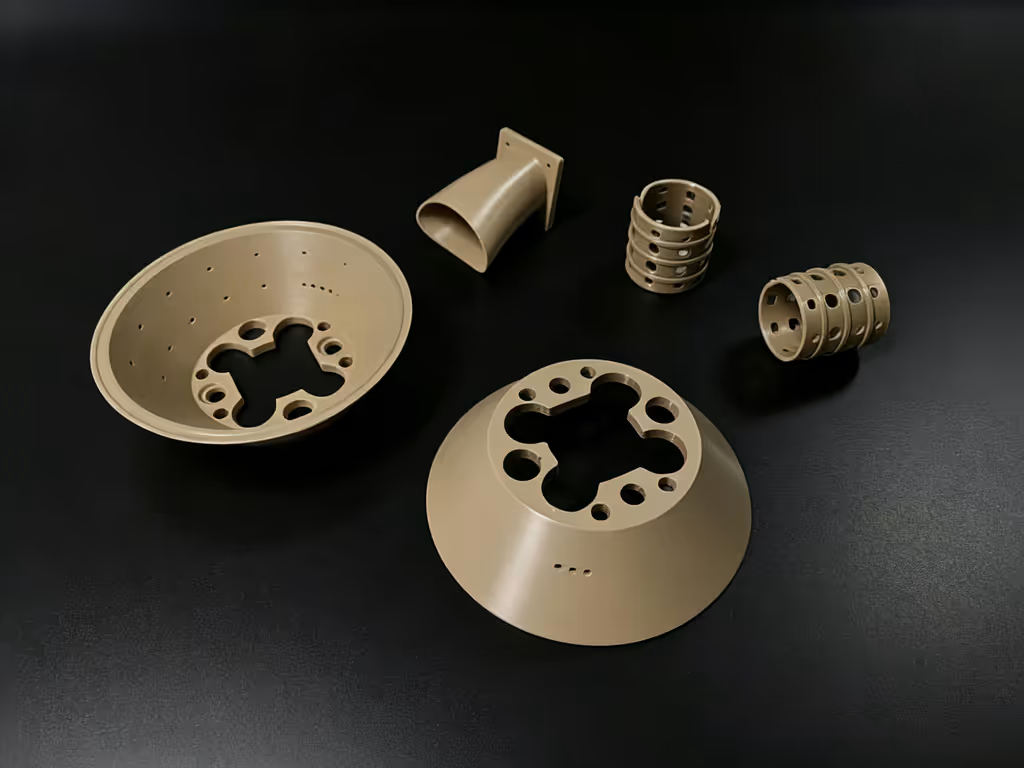
At INFREDAR,we do not believe in blindly replacing every component with PEEK. Instead, we apply it strategically where it delivers the most practical value. For instance, in our IPVS-31P and IPVS-14 mini models, we utilize PEEK for the main housing and hinge components to achieve high strength and significant weight reduction.
Simultaneously, we retain metal for the optical systems and dovetail mounts. This hybrid approach ensures the absolute precision required for optical imaging while carefully managing production costs.
If you would like to discuss night vision material selection or supply chain solutions, we welcome you to contact our technical experts.